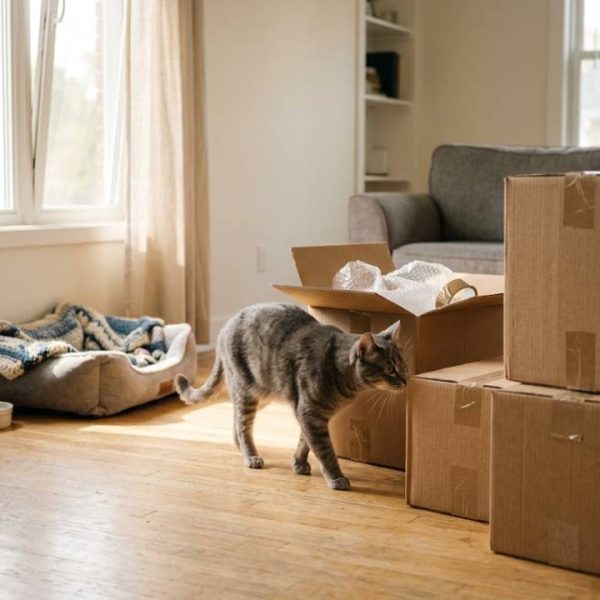
Cats are creatures of territory. Their sense of safety is built on familiar smells, sounds, hiding places and routines. An international move takes all of that away at once and replaces it with a crate, an aircraft and a strange new home. Most cats adapt well in the end, but the first weeks can be stressful for them and for their owners. With the right approach, you can make the transition much smoother.
This guide focuses on what happens after arrival: how to help your cat feel at home in a new country.
Prepare one safe room
Instead of letting your cat explore the whole new home at once, set up a single quiet room before you open the carrier. Include the litter box, food and water, a scratching post, a hiding place and items that smell of the old home, such as a blanket or a worn T-shirt. A small, controlled space helps a cat rebuild its sense of territory step by step.
Keep this room closed for the first days, especially while movers are still coming and going. Gradually open other rooms once your cat eats, uses the litter box and starts exploring calmly.
Use scent to your advantage
Cats rely heavily on smell. Rubbing a soft cloth on your cat's cheeks and then on furniture and door frames at nose height spreads familiar scent through the new home. Synthetic pheromone diffusers can also help some cats feel calmer. Avoid strong cleaning products or air fresheners during the first weeks.
Keep routines familiar
Feed at the same times as before, use the same food and the same type of litter. If the time zone has changed, shift meal times gradually rather than all at once. Play sessions at regular times help burn off nervous energy and strengthen the bond with you.
Indoor first, outdoor later
If your cat used to go outside, keep it indoors for at least three to four weeks after the move. Cats that are let out too early can try to find their way back to a home that no longer exists. When you do start outdoor access, go out together, choose quiet times and make sure the microchip details are updated with your new address and phone number.
Find a vet and understand local rules
Register with a local vet soon after arrival. Bring all medical records, vaccination history and details of any treatments. Different countries have different parasite risks and vaccination schedules, so ask what is recommended locally. Some cities also require pets to be registered with the local authority.
Language can complicate this step. If you moved from Germany, your vet records may be in German, and german to english translation services help a new vet in an English-speaking country understand your cat's history quickly. Many Ukrainian families who relocated with their pets in recent years have needed the reverse, with ukrainian translation of vet instructions, registration forms and insurance documents so they could follow local requirements confidently.
The same paperwork problem appears in almost every relocation file, not just in a cat's vet records. Passports, vaccination certificates, rental contracts and school reports all have to make sense to officials who read another language. That is why many families arrange document translation services for the whole move in one order, so every record is ready before a vet, a landlord or an authority asks for it.
Watch for signs of stress
Some stress is normal after a move. Signs to watch for include hiding for long periods, not eating, over-grooming, urinating outside the litter box or unusual aggression. Most cats improve within a couple of weeks. If symptoms continue or your cat stops eating for more than a day or two, contact a vet promptly. The welfare charity International Cat Care offers reliable advice on feline behaviour and stress.
Introduce new people slowly
New neighbours, visitors and household staff can overwhelm a nervous cat. Let your cat approach people in its own time, and ask visitors not to chase or pick it up. Calm, quiet introductions build confidence far faster than forced contact.
How relocation services support owners
Professional pet relocation services increasingly offer aftercare advice in the owner's own language: settling-in guides, checklists and contact details for local vets. Companies working across many countries manage these materials with a translation management system, so that a guide updated in English is quickly reflected in every other language they support. For owners, that means accurate, current advice when it matters most.
Multi-pet households
If you moved with more than one pet, the new home can reset old relationships. Cats that lived peacefully together may suddenly hiss at each other because they smell of the journey and the vet. Give each animal its own resources at first: separate bowls, litter boxes and resting places. Reintroduce them gradually, as if they were meeting again.
Give it time
Every cat adapts at its own pace. Some walk out of the carrier and claim the sofa within an hour. Others need weeks before they feel truly at home. Patience is the most important tool you have. Celebrate small steps: the first nap in a sunny spot, the first purr on your lap, the first curious look out of the new window.
A new territory to call home
Helping a cat settle after an international move is about rebuilding safety. A quiet safe room, familiar scents, steady routines, a gradual introduction to the outdoors and a good local vet all play their part. With patience and care, your cat will soon treat the new home as if it had always lived there.